Gift Now or Leave for Later? The Tax Considerations Behind the Decision

For families planning to transfer significant wealth, one of the most consequential decisions may also be one of the most fundamental: Should assets be transferred during your lifetime or retained and ultimately passed through your estate?
Lifetime gifting can offer meaningful estate-planning advantages. But transferring an asset sooner is not automatically better than transferring it later. The answer can depend on the interaction among estate taxes, income taxes, future appreciation and the donor’s own financial needs.
The Case for Gifting During Your Lifetime
One potential advantage of lifetime gifting is the ability to move future appreciation outside of your estate.
Consider an asset worth $1 million today that is expected to grow substantially over the next decade. If the asset remains in your estate, that future appreciation may increase the value of your taxable estate. If the asset is transferred today, subsequent appreciation generally occurs outside of your estate.
However, that result generally depends on the gift being a completed transfer—meaning the donor has truly given up control—and on the donor not retaining interests or powers that can pull the asset back into the estate under the estate-inclusion rules (including IRC §§2035–2038).
For families with potential estate tax exposure, that distinction can be significant. Lifetime gifts can also allow family members to benefit from wealth sooner, when those resources may be particularly useful. But removing an asset from an estate can introduce another tax consideration.
The Case for Retaining an Asset
Assets transferred during life generally carry the donor’s cost basis with them. Assets inherited at death, by comparison, generally receive a basis adjustment to fair market value at that time, subject to applicable rules and exceptions.
That Creates an Important Tradeoff.
An asset with substantial appreciation potential may be attractive to transfer today because future growth can occur outside the estate. But an asset that already has a significant unrealized gain may be advantageous to retain if a basis adjustment at death could meaningfully reduce the income tax associated with a future sale.
The decision therefore requires looking at potential estate tax savings and potential income tax consequences together.
Factors That Can Influence the Timing Decision
There is no single factor that determines whether an asset should be transferred during life or retained. Instead, several considerations can shift the analysis.
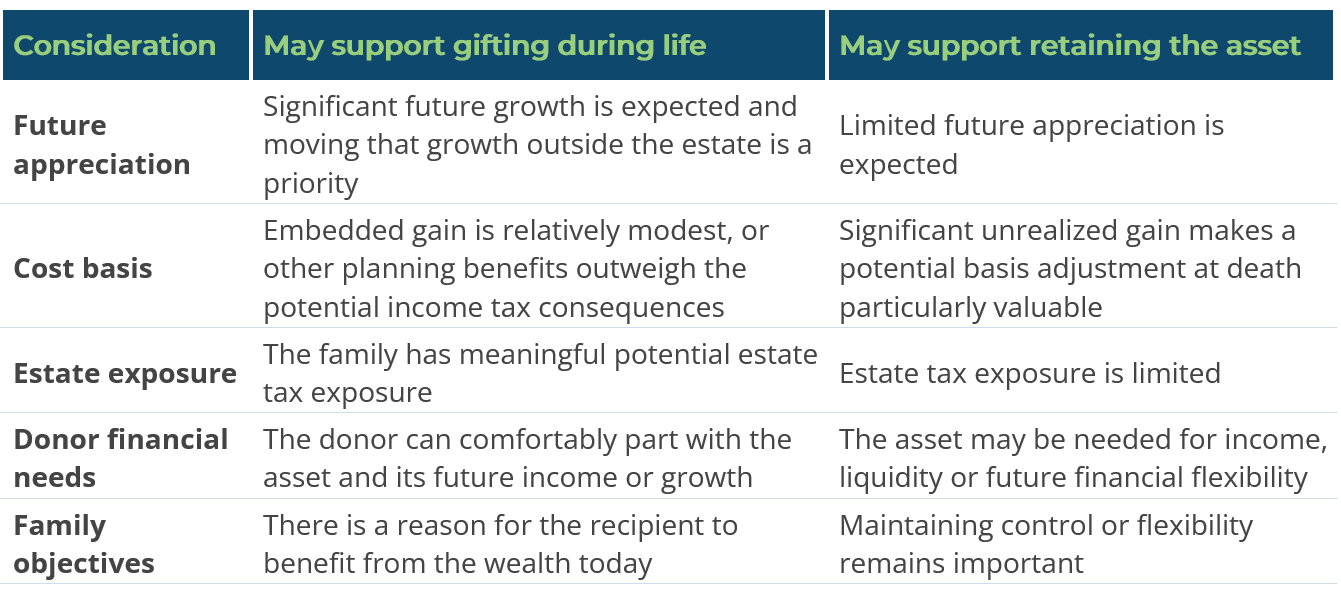
These considerations also illustrate why the decision cannot be made based on a single tax outcome. The same asset can look very different depending on the family’s broader financial circumstances.
Time Can Change the Calculation
The appropriate strategy does not have to be static. An asset that makes sense to retain today could become a gifting candidate later. Changes in asset values, tax laws, family circumstances or the donor’s financial position can alter the analysis.
That makes gifting less of a one-time decision and more of an ongoing planning process. Periodically reviewing which assets you own, how they have performed and how they fit within your broader estate plan can reveal opportunities that may not have existed previously.
Timing can also affect what you choose to transfer. An asset’s basis, appreciation potential and role within the portfolio can all influence whether it is a good candidate for a lifetime gift. Learn more about choosing the right assets for a lifetime gift.
Look Beyond Taxes
Tax consequences are important, but they are not the only consideration. A lifetime gift permanently changes the donor’s balance sheet. Before transferring significant wealth, consider whether sufficient assets and liquidity will remain to support future spending, health care, lifestyle and other financial needs.
The purpose of the wealth matters, too. Some families want the next generation to benefit from assets during the donor’s lifetime. Others may prioritize maintaining flexibility or control. Those objectives can affect both the timing and structure of a transfer.
Rather than asking whether it is more tax-efficient to give now or leave assets later, consider a broader question: “When can this wealth be transferred most effectively given the family’s tax position, financial needs, and long-term objectives?”
For some assets, the answer may be today. For others, it may be later.
The goal is not necessarily to transfer wealth as early as possible, or retain it as long as possible. It is to be intentional about when wealth changes hands and why.
Disclosures: The information provided is general in nature, is provided for informational purposes only, and should not be construed as financial, tax, or legal advice. The views expressed by the author are based upon the data available at the time the article was written. Any such views are subject to change at any time. Clearstead disclaims any liability for any direct or incidental loss incurred by applying any of the information in this article. All financial decisions must be evaluated as to whether they are consistent with your objectives and financial situation. You should consult with a financial, tax or legal professional before making any decisions.
Related or Tagged New Posts

financial guidance
October 8th 2026
What You Give Matters: Choosing the Right Assets for a Lifetime Gift

financial guidance
October 6th 2026
The n=1 problem: Why Investing Successfully in a Single Early-Stage Company Is So Hard

financial guidance
October 2nd 2026
Financial Planning for Dental Practice Owners: Balancing Your Practice, Personal Wealth and Retirement in 2026

financial guidance
September 24th 2026
Why Bonds May Deserve Your Attention Now

financial guidance
September 3rd 2026
Investing with Intention: What Is the Purpose of Family Wealth?

financial guidance
July 6th 2026
Liquidity as Strategy: How Planning Before and After the Event Creates Advantage

financial guidance
May 27th 2026
What Are Trump Accounts? A Guide to the New Savings Vehicle for Children

financial guidance
May 8th 2026
Your IRA May Be the Most Overlooked Risk in the Modern Estate Plan

financial guidance
April 24th 2026
Beyond the Wealth Transfer: How Families Prepare Across Generations

financial guidance
February 19th 2026
Early Tax Planning Makes a Difference

financial guidance
February 10th 2026
Tax Planning Gets More Complex as Wealth Grows

financial guidance
December 1st 2025
Charitable Bunching and Donor Advised Funds Considering Higher Standard Deductions