OBSERVATIONS
- Markets traded higher last week as the US and Iran inched closer to a deal to re-open the Strait of Hormuz. The S&P 500 gained 2.4% and small caps (Russell 2000) gained 1.7%, while the yield of the 10-year Treasury fell one basis point to end the week at 4.36%.[1]
- New home sales for March were 682k (annualized rate), 7.4% higher than February’s 635k annualized rate. New home sales in March have rebounded from January’s 3-year low and are back to 3-year average levels.[1]
- The ISM Services PMI came in largely as expected in April, falling slightly below March’s 54 figure to 53.6—any number above 50 signals expanding economic activity. The decline was largely driven by a decline in the new orders component, which is now slightly below its average over the past year.[1]
- Q1 productivity came in better than expected, registering a 0.8% gain over the previous quarter. As compared to last year, productivity increased by 2.9%, higher than Q4-2025’s 2.5% year-over-year (YoY) gain. Unit labor costs fell to 2.3% YoY in Q1, an improvement from Q4-2025’s 4.4% YoY figure. Both readings provide evidence of US firms’ ability to increase profit margins despite input cost pressures.[1]
- Job openings were little changed in March (latest available), falling to 6.87 million from February’s 6.92 million openings. The quit rate, a proxy for workers’ confidence about finding a new job, increased to 3.17 million, up from 3.05 million quits in February, which is further evidence the labor market remains stable.[1]
- Similarly, initial unemployment claims remain low, despite increasing by 10k last week to 200k total new claims. Compared to the same week last year, there were 25k fewer claims.1
- The economy created 115k new jobs in April and the unemployment rate remained unchanged at 4.3%.[1]
- The University of Michigan consumer sentiment indicator fell to 48.2 in May from April’s 49.8 reading driven by concerns over higher prices—this is the lowest reading on record in 74-year history of the survey.[1]
EXPECTATIONS
- Approximately 89% of the S&P 500 have reported Q1 earnings, and 84% of companies are reporting a positive earnings surprise, which is better than the 5-year (78%) and the 10-year (76%) average. Overall, Q1 earnings are on track to grow by 27.7% YoY.[2]
ONE MORE THOUGHT: AI Datacenter Build-Out Driving Economic Growth[3]
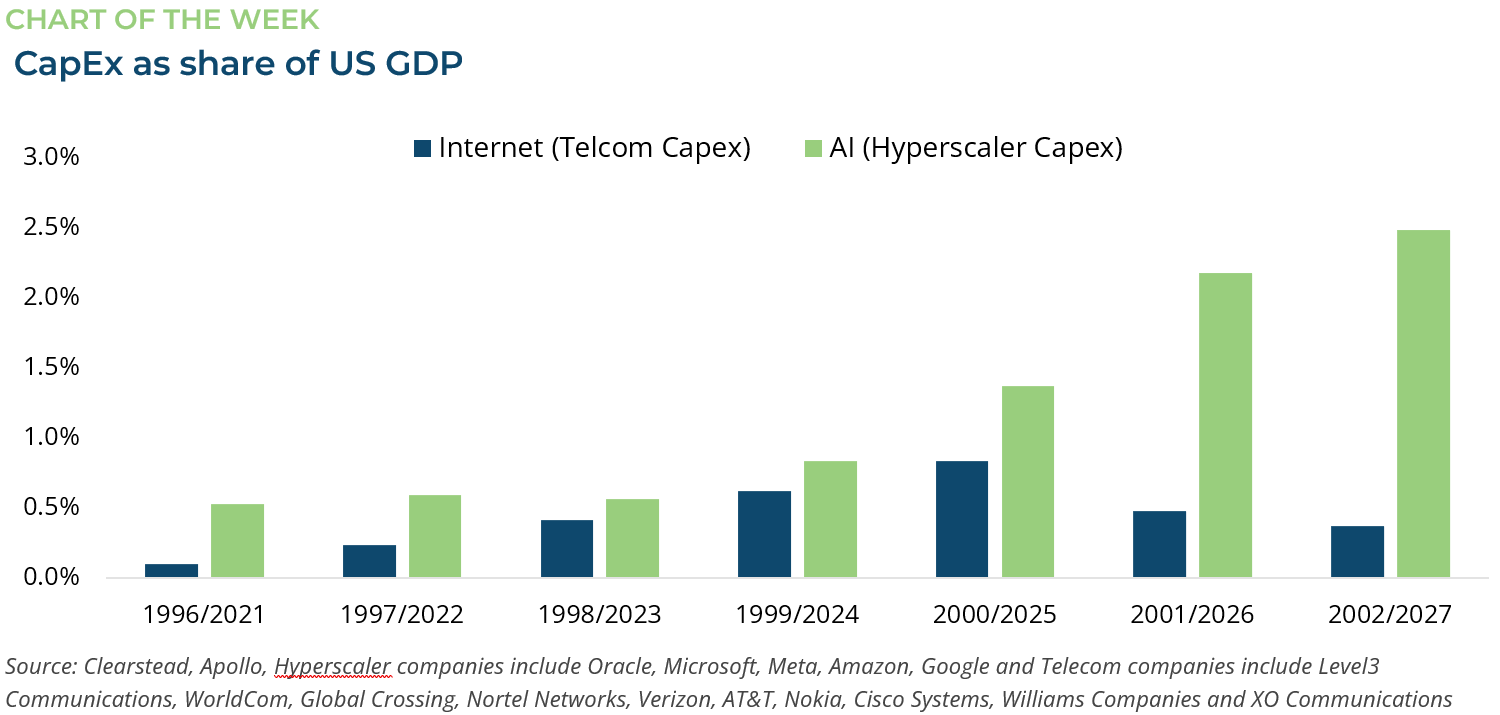
AI (artificial intelligence) has evolved into a major channel of capital formation in the U.S. economy. Last year, the major hyperscalers—Amazon, Alphabet, Meta, Microsoft, and Oracle—spent about $400 billion dollars on capital expenditures (CapEx) related to AI models, datacenters, and related equipment. Initial estimates by industry analysts projected $650 million to be spent on CapEx by the hyperscalers in 2026, but this figure has grown to over $700 billion in recent weeks. To put this in perspective, this is equivalent to the entire GDP of countries like Sweden, Argentina, or Singapore, or just over 2% of total 2026 US GDP. Forecasts for hyperscaler CapEx for 2027 are hovering around $900 billion, with some analysts projecting CapEx spend as high as $1 trillion. Looking ahead, McKinsey estimates that global data center investment tied to AI could require about $5.2tr by 2030, with total data center capital spending approaching $6.7 trillion worldwide. This massive AI-ecosystem buildout is already having an impact on the real economy. The initial estimate of real GDP growth in Q1 was 2.0%, of which approximately 1/3 was directly attributed to non-residential fixed investment in information-processing equipment. Analysis by the Federal Reserve showed that over 90% of economic growth in 2025 was due to the AI buildout, and absent this activity, growth would have been flat. Data center construction has created meaningful demand for electricians, welders, HVAC workers, and other skilled tradesmen. Goldman Sachs reported that construction jobs exposed to the AI buildout have increased by 216,000 since 2022 and that construction employment growth over the past three years would have been half of the current rate absent the buildout. Thus far, the buildout appears to have a limited and indirect effect on inflation measures. The clearest channel is electricity, as growing datacenter electricity demand is putting upward pressure on power prices in select regions. Overall, AI and datacenter spending is not merely a technology story. It is increasingly central to the current macroeconomic narrative with implications for GDP, manufacturing, investment, and energy demand. In 2000, telecom investment in fiber-optics and the internet buildout peaked at about 1% of GDP. Next year, AI-oriented investments will likely reach 2.5% of US GDP. The central question is whether this investment boom will ultimately generate sustained productivity gains, growth, and positive returns on capital, or will the US economy find itself having misallocated capital for several years? The implications for corporate profits, stock market returns, and US GDP growth could not be greater.

[1] Bloomberg LP, 5/8/2026
[2] FactSet Earnings Insight 5/8/2026
[3] https://www.stlouisfed.org/on-the-economy/2026/jan/tracking-ai-contribution-gdp-growth; https://www.goldmansachs.com/insights/articles/how-will-ai-affect-the-us-labor-market; https://www.apolloacademy.com/wp-content/uploads/2026/02/Hyperscaler-capex-022226_v2.pdf
Information provided in this article is general in nature, is provided for informational purposes only, and should not be construed as investment advice. These materials do not constitute an offer or recommendation to buy or sell securities. The views expressed by the author are based upon the data available at the time the article was written. Any such views are subject to change at any time based on market or other conditions. Clearstead disclaims any liability for any direct or incidental loss incurred by applying any of the information in this article. All investment decisions must be evaluated as to whether it is consistent with your investment objectives, risk tolerance, and financial situation. You should consult with an investment professional before making any investment decision. Performance data shown represents past performance. Past performance is not an indicator of future results. Current performance data may be lower or higher than the performance data presented. Performance data is represented by indices, which cannot be invested in directly.
Related or Tagged New Posts
market perspectives
October 6th 2026
Quarterly Market Insights | 3Q26

market perspectives
October 6th 2026
September Review 2026

market perspectives
October 5th 2026
Research Corner | 10/5/2026
market perspectives
September 28th 2026
Research Corner | 9/28/2026
market perspectives
September 21st 2026
Research Corner | 9/21/2026
market perspectives
September 14th 2026
Research Corner | 9/14/2026
market perspectives
September 8th 2026
August Review 2026
market perspectives
September 8th 2026
Research Corner | 9/8/2026
market perspectives
August 31st 2026
Research Corner | 8/31/2026
market perspectives
August 24th 2026
Research Corner |8/24/2026
market perspectives
August 17th 2026
Research Corner | 8/17/2026
market perspectives
August 10th 2026
Research Corner 8/10/2026