OBSERVATIONS
- Markets traded higher last week, and the S&P 500’s winning streak extended to nine consecutive weeks. The S&P 500 gained 1.4%, small caps (Russell 2000) gained 1.8%, while the yield on the 10-year fell 12 basis points to end the week at 4.44%.[1]
- Housing prices were largely stable in March (latest available) as the S&P CoreLogic Case-Shiller National Home Price Index rose 0.7% year-over-year (YoY), which was just below February’s revised 0.8% YoY rate.[1]
- New home sales declined to 622k (annualized rate) in April, which was a 6.2% month-over-month (MoM) decline compared to March and below consensus expectations.[1]
- Durable goods orders, in contrast, beat expectations and registered a 7.9% MoM gain. However, excluding the volatile transportation component—both autos and planes—durable goods orders only increased 1.1% MoM but this was also well ahead of expectations.[1]
- Initial unemployment claims increased 5k from the week prior to reach 215k new claims. Claims remain very low and there were almost 20k fewer claims than the same week last year.[1]
- The initial estimate of Q1 GDP growth was revised down from 2.0% to 1.6% (annualized rate) due to downward revisions to consumer spending and less inventory stocking.[1]
- The Fed’s preferred gauge of inflation, the PCE price index, came in as expected but also indicated that inflationary pressures are moving higher. Headline PCE registered a 3.8% YoY increase in April—higher than March’s 3.5% YoY rate—while core-PCE, which removes food and energy, rose to 3.3% YoY which was also above March’s 3.2% YoY rate.[1]
EXPECTATIONS
- Oil prices traded lower last week—WTI crude fell to about $87 per barrel down almost 20% from its mid-month high of $108 per barrel—despite US attacks on select Iranian military targets, as talks to extend the US-Iran ceasefire continued and to provide a framework for a more permanent cessation of the military activities as well as restrictions on Iran’s nuclear program and its support to proxy militias in the region.[1]
- In the final take on Q1 earnings season, 97% of the S&P 500 have reported and 85% of firms have had a positive earnings surprise, above the 5-year (78%) and 10-year (76%) averages. Q1 earnings were up 28.6% YoY, which is the best quarter in over four years.[2]
ONE MORE THOUGHT: Momentum Defines May Equity Returns[1]
US equities had another strong month of gains. In just 19 trading days in May, the S&P 500 hit 10 separate new record highs—basically one every other day—and gained over 5.2% for the month. However, the gains for May were largely concentrated among tech stocks with semiconductor, memory, and AI stocks. Of the eleven sectors that comprise the S&P 500, eight (Communication Services, Consumer Staples, Energy, Financials, Industrials, Materials, Real Estate, and Utilities) posted negative returns for the month. While the Consumer Discretionary and Healthcare sectors gained more than 2%. However, the tech sector gained nearly 16% in May. The popular SOXX ETF that tracks the NYSE Semiconductor Index gained over 23% during the month and is up nearly 90% year-to-date. Indeed, the momentum behind the US semiconductor sector is actually reflective of a strong global surge in semiconductor stocks everywhere. The main Korean stock market index (KOSPI) is up nearly 250% since Jan-2025 led by Samsung (+460%) and SK Hynix (+1,190%), which joined the global trillion-dollar market cap club earlier this year. The Taiwanese firm TSMC, which is the largest global fabricator of semiconductors, has also gained more than 110% over this period. Given these eye-popping returns, it is not hard to see why leverage is growing in parts of the global semiconductor and memory chip trade. According to the Korean Financial Investment Association, margin loans have risen to around $26 billion, which is more than double since the start of 2025. In 2020, for instance, only $5 billion of margin debt was posted on the KOSPI. Similarly, in the US net margin debt as a share of total US equity market cap hit 1.26% at the end of April, which is the highest level on record going back to 1997. History teaches us that investors should become cautious when leverage meets euphoria. This summer is also likely to bring several mega-IPOs beginning with SpaceX in June, which is likely to bring even more excitement and interest in the AI space. Momentum trades can go on longer than one might initially expect and many of the companies that comprise the global AI ecosystem have had incredible earnings growth and are credibly projected to continue to grow sales, cash flows, and profits strongly over the coming quarters. However, as market leadership narrows to a very small number of firms, every day brings you closer to the day when all the good news and upside is fully priced in and all that is left is volatility.
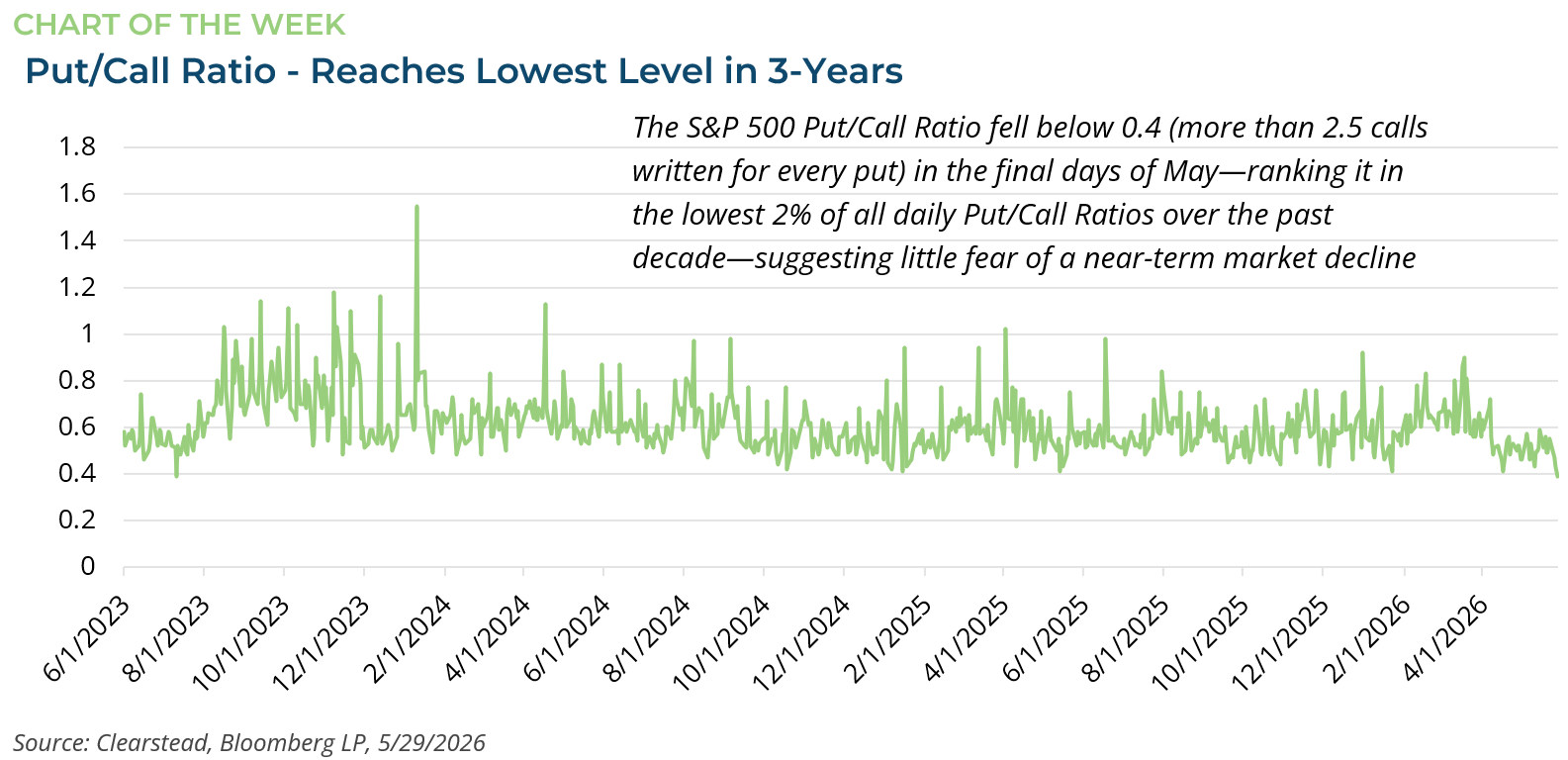

[1] Bloomberg LP, 5/29/2026
[2] FactSet Earnings Insight 5/29/2026
Information provided in this article is general in nature, is provided for informational purposes only, and should not be construed as investment advice. These materials do not constitute an offer or recommendation to buy or sell securities. The views expressed by the author are based upon the data available at the time the article was written. Any such views are subject to change at any time based on market or other conditions. Clearstead disclaims any liability for any direct or incidental loss incurred by applying any of the information in this article. All investment decisions must be evaluated as to whether it is consistent with your investment objectives, risk tolerance, and financial situation. You should consult with an investment professional before making any investment decision. Performance data shown represents past performance. Past performance is not an indicator of future results. Current performance data may be lower or higher than the performance data presented. Performance data is represented by indices, which cannot be invested in directly.
Related or Tagged New Posts

market perspectives
October 6th 2026
Quarterly Market Insights | 3Q26

market perspectives
October 6th 2026
September Review 2026

market perspectives
October 5th 2026
Research Corner | 10/5/2026
market perspectives
September 28th 2026
Research Corner | 9/28/2026
market perspectives
September 21st 2026
Research Corner | 9/21/2026
market perspectives
September 14th 2026
Research Corner | 9/14/2026
market perspectives
September 8th 2026
August Review 2026
market perspectives
September 8th 2026
Research Corner | 9/8/2026
market perspectives
August 31st 2026
Research Corner | 8/31/2026
market perspectives
August 24th 2026
Research Corner |8/24/2026
market perspectives
August 17th 2026
Research Corner | 8/17/2026
market perspectives
August 10th 2026
Research Corner 8/10/2026