OBSERVATIONS
- Markets traded lower last week as the US-Iran conflict re-escalated. The S&P 500 lost 1.6% and small caps (Russell 2000) lost 0.5%, while the yield on the 10-year Treasury was close to unchanged, falling 1 basis point to end the week at 4.55%.1
- Small business optimism rose in June to 97.4—a 2.1-point increase from May and nearing its 52-year average (98)—as expectations for business conditions and expected sales both improved.1
- Inflation figures came in better than expected for June, with the CPI falling to 3.5% year-over-year (YoY)—expectations were for 3.8% YoY—from May’s 4.2% YoY rate. Core-CPI, which removes the volatile food and energy categories, also beat expectations and fell to 2.6% YoY in June down from May’s 2.9% YoY rate.1
- Producer prices also declined in June more than expected. Headline PPI fell to 5.5% YoY in June, which was down markedly from May’s 6.5% YoY rate. Core-PPI, which removes food and energy, also eased in June to 4.7% YoY from May’s 4.9% YoY rate.1
- Retail sales grew by 0.2% month-over-month (MoM) in June, which is a slower pace than the 1.0% MoM increase in May retail sales. However, excluding the volatile gas and auto segments, retail sales increased by 0.5% in June—faster than the headline figure but also slower than May’s ex-auto and gas 0.8% MoM rate.1
- The national Housing Market Index fell to 34 in July from June’s 35 level as homebuilders noted declines across all three components—current sales conditions, sale expectations and buyer traffic at model homes.1
- Initial unemployment claims remain low and registered 208k last week, a decline of 8k from the previous week. Similarly, there were more than 16k fewer claims than the corresponding week last year.1
- The Univ. of Michigan Consumer Sentiment Index moved up to 54.4, the highest reading since February, driven by broad improvements across all categories, including current and expected economic conditions.1
EXPECTATIONS
- Q2 earnings season kicked-off last week, with major US banks—Goldman Sachs, JPMorgan, Wells Fargo, Morgan Stanley and Citibank—beating expectations and delivering strong Q2 2026 earnings driven by surging trading revenues, investment banking fees (underwriting and M&A/AI-related deals), and solid consumer and commercial banking performance.1
ONE MORE THOUGHT: New Housing Law Designed to Lift US Housing Market1
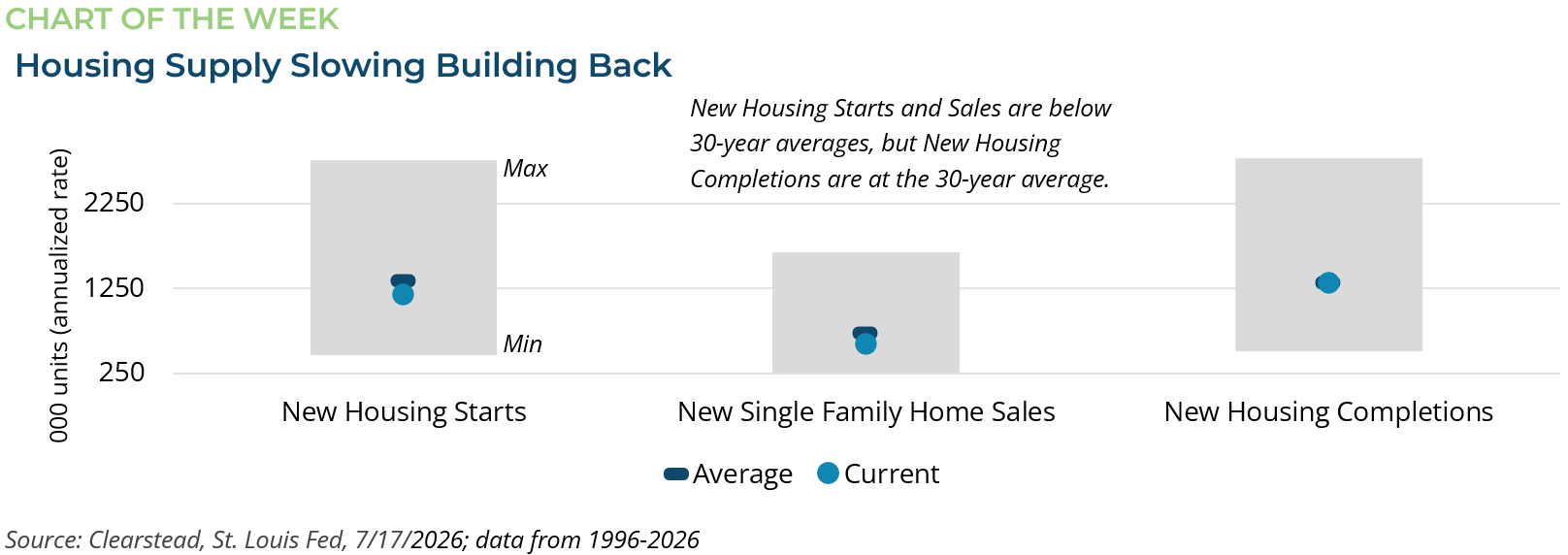
On July 11th, the 21st Century ROAD to Housing Act became law, introducing a structural legislative framework designed to address the systemic challenges underlying the American housing market. Rather than relying solely on traditional federal subsidies, this statute targets market dominance, regulatory friction, and housing supply through three primary pillars: curbing institutional real estate acquisitions, mitigating bureaucratic barriers, and promoting architectural innovation. To protect retail buyers from artificially inflated competition, the act imposes strict statutory limits on institutional investors. Over the past decade, private equity and institutional managers have aggressively acquired single-family housing inventories, outbidding retail buyers and escalating values. The act addresses this distortion by establishing a hard regulatory ceiling, prohibiting corporations with portfolios exceeding 350 single-family residential properties from executing further acquisitions, backed by a $1 million statutory penalty per violation. While the law lacks retroactive provisions to compel divestment, freezing further corporate buying should help restore market equilibrium for prospective household buyers. The legislation also tackles supply-side constraints caused by local regulatory inflation and protracted administrative delays. To mitigate the impact of restrictive land-use policies and environmental assessments, the framework establishes a federal incentive structure that rewards municipal and state governments for liberalizing localized zoning laws. Concurrently, the statute mandates an expedited review process for projects under the purview of the Department of Housing and Urban Development (HUD) to lower the baseline costs of affordable development. Furthermore, the act prioritizes architectural modernization and urban adaptive reuse to expand national inventory. A key reform clears the path for cost-effective modular construction—easing the ability to get a loan for so called “manufactured houses” (modern mobile homes without an axel). Beyond greenfield development, the legislation introduces the RESIDE Act, a grant program engineered to facilitate the adaptive reuse of vacant commercial real estate into high-density residential units, supplemented by rehabilitation grants to preserve existing low-income housing stock. Regulatory frameworks for community financial institutions have also been modified, expanding local banks’ capacity to invest in affordable housing tax credits. Ultimately, the act shifts federal housing policy from reactive spending to structural reform, positioning systemic deregulation and market stabilization as the dual pillars of affordability. For investors, the read-through is meaningful but gradual. Homebuilders, building products suppliers, and modular-construction firms stand to benefit if permitting and review timelines are reduced. However, the binding constraint on affordability—financing costs—still rests with the bond market. We caution against treating any single bill as a turning point for the housing market, and we will monitor federal implementation closely. The road has been mapped; how quickly we travel it now rests with the states.

[1] Bloomberg LP, 7/17/2026
Information provided in this article is general in nature, is provided for informational purposes only, and should not be construed as investment advice. These materials do not constitute an offer or recommendation to buy or sell securities. The views expressed by the author are based upon the data available at the time the article was written. Any such views are subject to change at any time based on market or other conditions. Clearstead disclaims any liability for any direct or incidental loss incurred by applying any of the information in this article. All investment decisions must be evaluated as to whether it is consistent with your investment objectives, risk tolerance, and financial situation. You should consult with an investment professional before making any investment decision. Performance data shown represents past performance. Past performance is not an indicator of future results. Current performance data may be lower or higher than the performance data presented. Performance data is represented by indices, which cannot be invested in directly.
Related or Tagged New Posts

market perspectives
September 21st 2026
Research Corner | 9/21/2026
market perspectives
September 14th 2026
Research Corner | 9/14/2026

market perspectives
September 8th 2026
August Review 2026
market perspectives
September 8th 2026
Research Corner | 9/8/2026
market perspectives
August 31st 2026
Research Corner | 8/31/2026
market perspectives
August 24th 2026
Research Corner |8/24/2026
market perspectives
August 17th 2026
Research Corner | 8/17/2026
market perspectives
August 10th 2026
Research Corner 8/10/2026
market perspectives
August 7th 2026
July Review 2026
market perspectives
August 3rd 2026
Research Corner | 8/3/2026
market perspectives
July 27th 2026
Research Corner | 7/27/2026
market perspectives
July 13th 2026
Research Corner | 7/13/2026