OBSERVATIONS
- Markets were mixed last week with the S&P 500 gaining 1.2%, while small caps (Russell 2000) lost 0.8%. Meanwhile the yield on the 10-year Treasury rose 16 basis points to end the week at 5.16%.1
- 10-year interest rates responded to two separate weaker Treasury auctions as well as industry surveys that suggested strong economic activity and higher input prices for both the manufacturing and service sectors.1
- New home sales beat expectations for August rising by 6.4% month-over-month (MoM) to 684k (annualized rate) and July’s new home sales were revised higher to 643k—sales were strongest in the Midwest region.1
- Initial unemployment claims fell 1k from the week prior to 197k last week. Initial claims remain very low and there were 17k fewer claims compared to the same week last year.1
- Total durable goods orders were flat in August (0.0% MoM), but durable goods orders excluding transportation—autos and planes—increased by 0.3% MoM.1
EXPECTATIONS
- In the aftermath of the Fed’s rate hike decision earlier in the month and a bevy of Fed speakers last week, markets have priced in a nearly 65% chance that the Fed will hike its main policy rates by 25 basis points when it meets again in late October.1
- US and Iran held indirect talks last week mediated by Qatari and Pakistani diplomats on the fringes of the UN General Assembly meetings, but little progress was made on major sticking points. Nonetheless, both parties seemed to agree that more substantial discussions could be held in the coming weeks.1
- President Trump and Chinese President Xi met last week in a bilateral summit that focused on several contentious bilateral issues such as US tariffs, Chinese restrictions on rare earth exports, AI, and several foreign policy issues (Iran, Russia, and Taiwan). The talks produced limited agreements on US agricultural shipments to China, extended the trade-truce for two months, and avoided any further restrictions on trade between the two countries. President Xi and Trump are set to meet again in Shenzhen, China during the November APEC Summit as well as in December in Miami at the G20 Summit.1
ONE MORE THOUGHT: Shortages of Refined Petroleum Products Could Push Up Inflation1,2
The Fed’s fight against inflation is being complicated not only by the recent rises in crude oil prices but more recently with the disconnect between crude oil and the prices of refined oil products such as diesel fuel and jet fuel. Both of these products typically trade at a premium to a barrel of oil. Historically, for instance, a barrel of diesel fuel has had a premium of about $30 dollars compared to a barrel of West Texas Intermediate crude. However, in recent weeks this premium—sometimes referred to as the crack spread—has surged to about $100 a barrel. Both jet fuel and diesel are the middle distillates of crude oil refining and thus they are refined at the same facilities. This means that an increase in diesel refining means making a tradeoff to refine less jet fuel at the same refinery. Because the two products rely on the same refineries the prices of diesel and jet fuel are closely linked. In recent weeks, diesel prices were at record highs and jet fuel prices were just below all-time highs. The surging of the crack spread is directly related to both the conflicts between the US and Iran as well as the war between Russia and Ukraine. Since March, when the US-Iran conflict commenced, much of the diesel and jet fuel refining in the Middle East has been offline. Historically, Russia has also been a large exporter of refined diesel fuel, but Ukrainian attacks in recent weeks have knocked out as much as 45% of Russia’s diesel refining capacity. As a result, Russia has banned any further diesel exports as they need the fuel for their own economy and military equipment. In the US, refineries have been working at full capacity. However, this cannot go on indefinitely. While refineries are currently reaping high profits, they are putting off necessary maintenance. Refineries typically operate at between a 90% to 95% utilization rate and utilize their downtime to refurbish equipment that is subjected to high temperatures and pressures. At present, most US refineries are running above a 95% utilization rate due to high demand for distillate products. Analysis by European investment bank Societe Generale has shown that in past periods of time when US refineries have worked at 97% or higher utilization rates, they typically experience over a 500% increase in unplanned maintenance outages over the next six months due to equipment failures. Diesel prices are at record highs, little relief looks likely in the near-term, and unplanned outages in the first half of next year could mean prices stay higher for longer. This matters to inflation because nearly every product that is bought via an e-commerce platform or is sold in a grocery store is transported via diesel-based trucking. About 10% of the cost of most fresh produce and meats is tied to transport to the grocery store, and almost all US farm equipment is diesel-based. This is likely to result in the record high diesel prices being passed along to US consumers in the form of higher prices covering a wide range of products in the months and quarters to come.
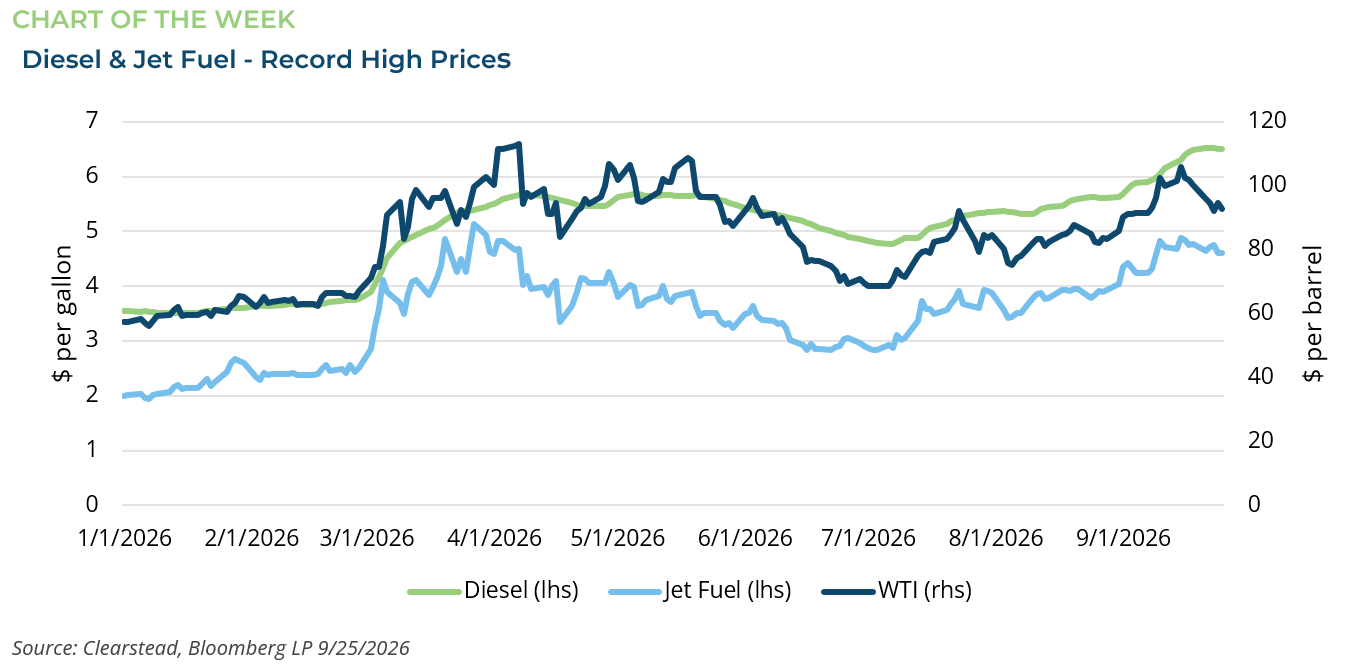

[1] Bloomberg LP, 9/18/2026
[2] Societe Generale “Global Strategy Weekly – Could Crack Spreads Crack the Bull Market” 9/16/2026
Information provided in this article is general in nature, is provided for informational purposes only, and should not be construed as investment advice. These materials do not constitute an offer or recommendation to buy or sell securities. The views expressed by the author are based upon the data available at the time the article was written. Any such views are subject to change at any time based on market or other conditions. Clearstead disclaims any liability for any direct or incidental loss incurred by applying any of the information in this article. All investment decisions must be evaluated as to whether it is consistent with your investment objectives, risk tolerance, and financial situation. You should consult with an investment professional before making any investment decision. Performance data shown represents past performance. Past performance is not an indicator of future results. Current performance data may be lower or higher than the performance data presented. Performance data is represented by indices, which cannot be invested in directly.
Related or Tagged New Posts

market perspectives
September 21st 2026
Research Corner | 9/21/2026
market perspectives
September 14th 2026
Research Corner | 9/14/2026

market perspectives
September 8th 2026
August Review 2026
market perspectives
September 8th 2026
Research Corner | 9/8/2026
market perspectives
August 31st 2026
Research Corner | 8/31/2026
market perspectives
August 24th 2026
Research Corner |8/24/2026
market perspectives
August 17th 2026
Research Corner | 8/17/2026
market perspectives
August 10th 2026
Research Corner 8/10/2026
market perspectives
August 7th 2026
July Review 2026
market perspectives
August 3rd 2026
Research Corner | 8/3/2026
market perspectives
July 27th 2026
Research Corner | 7/27/2026
market perspectives
July 20th 2026
Research Corner | 7/20/2026