OBSERVATIONS
- Markets traded lower last week as energy prices continued to rise. The S&P 500 lost 0.1% while small caps (Russell 2000) lost 1.5%. Amid a volatile week for fixed income markets, the 10-Year Treasury gained 3 basis points to end the week at 5.0%.1
- Retail sales came in better than expected in August with the headline figure rising 1.2% month-over-month (MoM) and retail sales excluding the volatile auto and gas categories rising at the same 1.2% MoM rate. Compared to August-2025, retail sales grew by 6.0% year-over-year (YoY).1
- NAHB Housing Index declined by 3 points to 32 in September, with a majority of home builders reporting current sales conditions deteriorating and anticipating weaker sales over the next six months.1
- Housing starts declined by 2.6% MoM to 1.275 million (annualized rate) in August. Over the first 8 months of 2026, total new housing starts are 1% behind the corresponding Jan-to-Aug 2025 period.1
- Initial unemployment claims came in below expectations and fell 10k to 196k new claims last week. This figure is over 40k fewer claims than the same week last year.1
- Industrial production was flat in August (0.0% MoM) with the manufacturing sub-sector being the weakest
(-0.3% MoM). Capacity utilization was unchanged in August at 76.3%.1
EXPECTATIONS
- West Texas Intermediate Crude is rising again towards the 2026 high ($112.95) and fluctuated between $100 to $105 per barrel last week, while the price of diesel fuel in the US ended last week at a record high of $6.49 per gallon.1
- The Bank of England, in a 6-to-3 vote, opted to keep interest rates unchanged at 3.75% but signaled that it may need to raise rates later in the year.1
- Meanwhile the Bank of Japan in a 7-to-2 vote, raised its main policy rate by 25 basis points to 1.25%—the highest rate in 31 years—to address both mounting inflationary pressures as well as weakness in the Japanese Yen.1
ONE MORE THOUGHT: A Hawkish Fed Rate Hike1
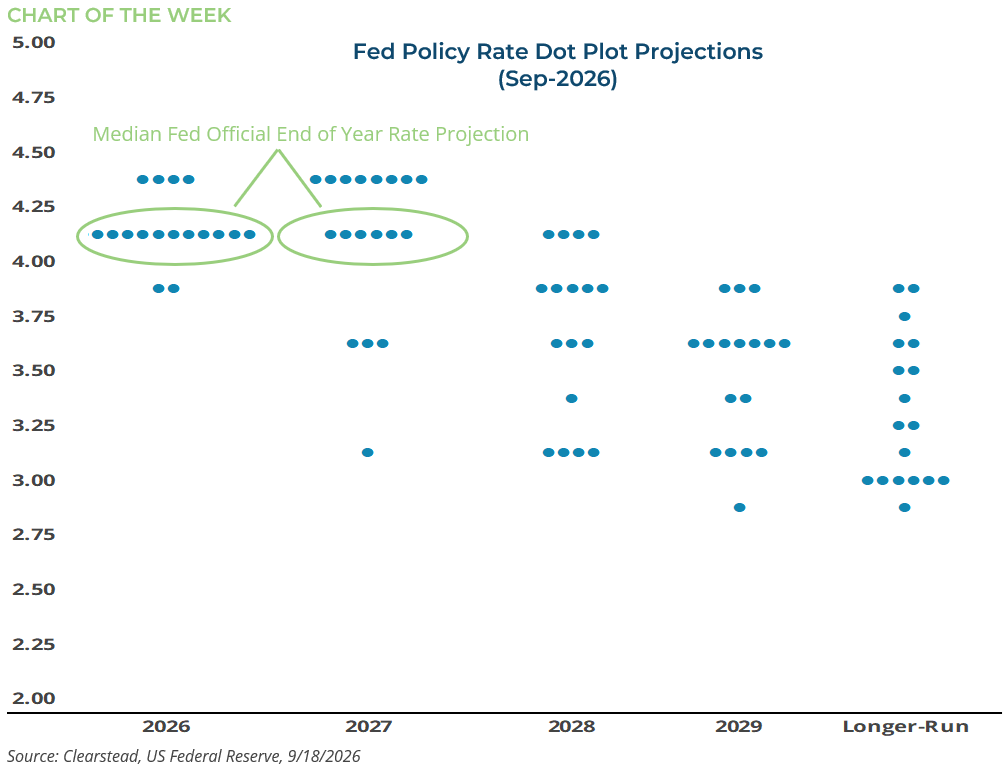
In a unanimous 12-0 vote last week, the US Federal Reserve raised the US policy interest rate range by 25 basis points to 3.75%-4.0%. This is the first time the Fed has raised its policy rate since July-2023. During the press conference, Fed Chairman Warsh emphasized that over the course of the summer it had become clearer that the US economy had strengthened and the US labor market was stable, but that various measures of inflation had not shown much easing. Furthermore, he noted the Fed’s preferred gauge of inflation (core-PCE) had not made much progress towards the Fed’s inflation target of 2.0%. As a result, the Fed’s decision was designed to modestly tighten financial conditions with the aim of bringing inflation down towards the Fed’s target in a “timelier” manner. While the Fed Chairman was careful not to provide any statement that could be construed as forward guidance, he stressed that the Fed’s focus should be on the inflation side of its mandate. Furthermore, the rest of the Fed’s decision-making committee released their estimates for the Fed Funds Rate in December, which showed that 16 of 18 Fed committee members anticipated at least one more hike this year—see Chart of the Week. The median official also indicated that they did not anticipate any rate movement in 2027. This is a change from the estimates from these Fed officials from June—the last time these projections were released—when they had forecasted only one 25 basis point rate hike this year and one 25 basis point rate cut in 2027. When asked what has changed since June, Chairman Warsh answered that the economy had strengthened, inflation remained stubborn, and geopolitical risks had increased. The Fed is not alone in its actions as the Bank of Japan and the European Central Bank also raised rates in September. For both banks, September’s rate move was the second hike of 2026. Global growth has shown itself to be remarkably resilient in the face of higher energy prices and stubborn inflationary pressures. As such, a new global central bank tightening cycle looks to be underway. Thus far, equity markets have been betting that the global corporate sector will be able to maintain margins and grow sales and earnings despite the upward movement in rates. This bet looks reasonable in the near term, but it warrants attention as the price of capital drifts slowly upwards.

[1] Bloomberg LP, 9/18/2026
Information provided in this article is general in nature, is provided for informational purposes only, and should not be construed as investment advice. These materials do not constitute an offer or recommendation to buy or sell securities. The views expressed by the author are based upon the data available at the time the article was written. Any such views are subject to change at any time based on market or other conditions. Clearstead disclaims any liability for any direct or incidental loss incurred by applying any of the information in this article. All investment decisions must be evaluated as to whether it is consistent with your investment objectives, risk tolerance, and financial situation. You should consult with an investment professional before making any investment decision. Performance data shown represents past performance. Past performance is not an indicator of future results. Current performance data may be lower or higher than the performance data presented. Performance data is represented by indices, which cannot be invested in directly.
Related or Tagged New Posts

market perspectives
September 14th 2026
Research Corner | 9/14/2026

market perspectives
September 8th 2026
August Review 2026
market perspectives
September 8th 2026
Research Corner | 9/8/2026
market perspectives
August 31st 2026
Research Corner | 8/31/2026
market perspectives
August 24th 2026
Research Corner |8/24/2026
market perspectives
August 17th 2026
Research Corner | 8/17/2026
market perspectives
August 10th 2026
Research Corner 8/10/2026
market perspectives
August 7th 2026
July Review 2026
market perspectives
August 3rd 2026
Research Corner | 8/3/2026
market perspectives
July 27th 2026
Research Corner | 7/27/2026
market perspectives
July 20th 2026
Research Corner | 7/20/2026
market perspectives
July 13th 2026
Research Corner | 7/13/2026